
Writing Studies
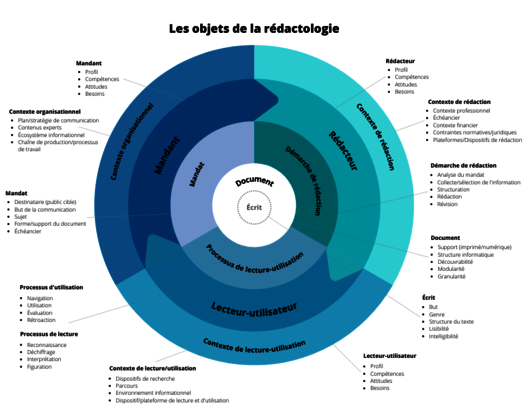
Rédactologie emerged in Canada in the early 2000s as the French counterpart of Writing Studies. It is therefore, a relatively recent discipline that aims to study clear writing in the professional field: this comprises journalism, web communication, the drafting of instructions, technical reports, leaflets and much more.
The origin of this discipline is linked to the emergence of the professional role of the copyeditor in certain French-speaking settings (Belgium, France, and Quebec). Copyeditors usually have a degree in the humanities, communication or journalism and are employed in various contexts such as institutional communication, webmarketing, journalism, and editorial assistance.

Even though this profession is not yet well-defined in Italy, the issue of written language is notoriously problematic. Francesco Sabatini reminds us that the Italian written language traditionally pays little attention to its readers, due to historical reasons: the writing style in institutional communication is rich in refined and polished expressions, but it often turns out to be unsuitable for practical situations. For example, until recently, emergency instruction signs like this one could be found on buses:
Attenzione: questa porta può funzionare come uscita di emergenza azionando il dispositivo posto sulla destra del mobiletto
Attention! This door can serve as an emergency exit by using the device on the right side of the cabinet
An alternative and more effective way to write the same sign could be as follows even if, as Sabatini observes, it would likely be perceived as trivial:
Per aprire la porta in caso di emergenza usa la maniglia qui accanto.
Pull this handle to open the door in case of emergency.
Italian speakers are so used to a refined register that it becomes difficult to find the correct ‘utilitarian’ register to draft documents.
(**) Francesco Sabatini, «L’italiano lingua utilitaria», in L’italiano lingua utilitaria. XI Incontro del Centro Linguistico Università Bocconi, 23 novembre 2002, a c. di Leandro Schena e Luciana Tiziana Soliman (Milano: EGEA, 2003), 17–22.
A reader-friendly writing style
Drafting a text in a clear, complete and compelling manner is the first step to engage the readers and keep them reading. Depending on the type of text that one wants to write, they will address a different audience. Some texts require a specific language with complex terms, whereas some others, aimed at a wider audience, ask for a clear and plain language style that is easier to grasp.
Wherever possible, it is better to replace technical and specific terms with more common ones or periphrases to facilitate their understanding.
When you start to write a text, it is important to have a clear idea of the points you want to discuss and to stick to a central topic without digressing too much, so that the texts will be easy to read.
Besides, it is important to contextualize the topic and to provide the reader with an adequate amount of information.
We must not take for granted that the reader has the same knowledge as the writer; a lack of clarification or unclear communication will leave the readers confused and they will remain with a lot of gaps while reading.
On the other hand, too much information can also be misleading and boring for the reader. Therefore, simplicity, clarity and readability are the grounds for good communication.
Finally, after drafting and reviewing the text, it is useful to get feedback a sample of target addressees.
(***) Clerc, Isabelle. “Quelles règles d’écriture se donner pour communiquer avec l’ensemble des citoyens du Québec?” Éla. Études de linguistique appliquée 195, no. 3 (2019): 305–24.
Translation Studies
In such a globalized world, however, it is increasingly harder to think from a monolingual perspective. For instance, Italy attracts a great amount of foreign tourists and from a country of emigration has become a country of immigration.
Many more languages are thus spoken within the national boundaries than some decades ago. This is the reason why drafting a practical text is even a more challenging task, as the audience we address is, and will increasingly be, a varied and multilingual one.
Thus, clear writing studies are naturally inclined to engage with another discipline: translation studies. As the name suggests, it is the study of translation, in all its forms(professional and non-professional, written and oral, as a product or a process). Together, these two disciplines can provide different theoretical and practical tools to ensure effective and multilingual communication. This is the main goal of our laboratory.
(FR)